
I'm sure you'll catch on sooner or later though. What does posting frequency have to do with bigpoopy spending several hours per day (for years) searching reviews for mistakes? Either he's deathly afraid he'll become destitute 2 decades from now and won't be able to afford the subscription or it's some ultra high level spectrum shit going on about making sure fuck reviews are perfected. Is he building his legacy as our own Johnny Appleseed?
Now, if you review my posts you'll find that I'll go after two groups of people. The first being the trolls that show up looking for attention by repeatedly posting inane shit and the other are folks that have chosen to launch an unprovoked attack in my direction. If you are one of the handful of folks that think I'm picking on them, you are or were in one of those two groups. Other than that, I'm just a joyful old guy with a long memory that logs in to see what's going on. This isn't a new thing by any means, the trolls and dipshits have been cycling thru these boards for decades.
I'll even give the folks in the first group some leeway but when it becomes an annoyance, I speak my mind and mostly thru direct sarcasm. If you're in the second group, that means you chose to escalate the engagement at some point and here we are


So I was doing my little "find the delister" side project, and I looked at all the profile fields.
We have age, height, but nothing about weight?
There is a "build" field but it's not really encompassing and is very vague. You can have athletic build being a cornerback and also can have athletic build being a defensive lineman. And a difference would be 100 pounds.
I mean, we have such specific and transient/temporary things such as hair length or hair color. I would think the majority of mongers would like to know approximate weight more than hair color or eye color.
And grooming is under a very straightforward "Pussy" field.
So it's not like delicate or temporary things aren't entered into the profile.
So why no weight? Is it some holdover from the old days or is it done for a specific purpose? It's like an elephant in the room.
Look on the review template and you'll find a category called "Provider's Appearance." Under that you'll fine "Build," with a range of choices like "Athletic" and "A few extra pounds," etc.
Did you read my post? I specifically mentioned the build field.
The build field is very vague and has very few set values.
Having someone "few extra pounds" doesn't tell you whether it's 140-180 or 180-200 or 220-250 range, does it?
Height field doesn't do this gymnastics.
-- Modified on 12/11/2025 12:28:20 PM
I agree it's vague but it's always worked for me. The problem, as with everything in the Review format, is that the first reviewer sets the field and it's hard to make changes after that, such as if she puts on a few pounds.
In my experience, looking at height, build, and photos accurate fields works for me. If her pictures are accurate, I can use height and build to determine whether she's my type or whether she's too heavy for me. And if her photos aren't accurate she's likely a no-go for me (unless I'm looking for a quick, cheap bbbj type of experience). That's my process.
.
As to adding a weight field, I'm not opposed but I'm also not sure how accurate hobbyists' estimates of a provider's weight would really be.
You're asking the first reviewers to be able to judge a provider's weight. That weight will stick with her profile for life.
What range do you suggest? Ten lbs on a 5'2 frame means a lot more than 5'7.
Women at my gym look thinner/ more lean at 125 lbs with more muscle than they did at 115 and a skinny build.
I know a lot of escort malls, particularly in Europe, have a weight filter, but still plenty of reviews and comments point to inaccuracies.
Read her reviews, judge her photos and decide. One more subjective data point won't help.
Providers once they claim the profile can submit a problem report and get things corrected.
I feel that a first reviewer will never fill in the blanks 100% accurately unless sitting down and filling out with her.
The problem is most providers do not know they can do so
Can also add or change rates and menu items-
Your explanation makes no sense.
All fields stick for life if not changed by the provider.
Including age.
Hence my subject line.
And regarding the other comment about providers updating, who's gonna admit they packed on 10 lbs? Maybe they'll update their breast appearance too as gravity does what it does.
I think you're getting much closer to what I think is the real crux of the issue.
...Including age."
Sorry, rocket, that's BULLSHIT. I've got 9,730 days of VIP membership in my account. That's over 26 years. You know how I got them? "Changing fields" by doing Problem Reports. It's incredibly easy if you know what you're doing...and you obviously don't!
Keep wasting your time playing "find the delister," whatever the fuck that is. If you really wanted to help your fellow mongers as you claim you do, you'd be "changing fields" to make providers' profiles more accurate. That way mongers wouldn't be surprised when they show up and the provider doesn't match her "fields." TER also wants the profiles to be accurate - that's why they give 2 days of VIP for every Problem Report. It's a lot easier than writing fake K-Girl reviews.
Yeah you can go and do problem reports.
Why? Every single age of provider stays static unless provider or someone else changes it
Whats the point of clients going and submitting bulk problem reviews for thousands of profiles? Change the fucking system so age gets incremented.
You like doing busy monkey work it seems. I don't. Sorry.
Did you really say I write FAKE kgirl reviews?
None of my reviews are fake. I've seen every girl on my reviews.
You're insulting me right now, never would I write a fake review, I'd rather cut off my balls. No, seriously. Accusing me of fake reviews is rich. Which ones do you think are fake?
I have all text messages stored and I can show you whichever ones you want. You're the first person on ter or any other site to make this dubious claim.
....it's a red flashing light that says you need to get a life beyond TER. Is it like a day job for you to just sit in here all day long, every day? The fact that you've submitted almost 5,000 problem reports is shocking in so many ways. Did your mother make you stay inside and clip coupons when the other boys were playing boy games and learning how to grow into men? How did this infatuation with micro-rewards begin?
You could probably be the subject for a psych thesis!
Or does it come naturally to you? That's a rhetorical question.
You actually had the gall to say to BPS: "Is it like a day job for you to just sit in here all day long, every day?" And yet, a quick check of the board's top posters reveals you are a close second to me (which, as a separate subject, amazes me because I didn't think I posted here that often but never mind).
Not only that, BPS is only the FIFTH most frequent poster with 184 FEWER posts than YOU over the past six months. Over the past 30 days, Scarlett is WAY in the lead over you. And you've got me beat by nearly 20 posts. And BPS doesn't even make the 30-day list.
Perhaps it's snafool who needs to get a life or at least stop calling the kettle black?
1. inicky46 295 October 2010
2. snafu929 274 August 2001
3. edinathens 165 February 2002
4. WIMissScarlet 102 October 2017
5. BigPapasan 90 March 2002
As for my posts, I think if you review them you'll find almost all are giving folks useful advice or kidding around. Whereas your posts are almost entirely you arguing with virtually everyone. So who's the one who needs a "psych thesis?"
Where is my prize?!?
I'm sure you'll catch on sooner or later though. What does posting frequency have to do with bigpoopy spending several hours per day (for years) searching reviews for mistakes? Either he's deathly afraid he'll become destitute 2 decades from now and won't be able to afford the subscription or it's some ultra high level spectrum shit going on about making sure fuck reviews are perfected. Is he building his legacy as our own Johnny Appleseed?
Now, if you review my posts you'll find that I'll go after two groups of people. The first being the trolls that show up looking for attention by repeatedly posting inane shit and the other are folks that have chosen to launch an unprovoked attack in my direction. If you are one of the handful of folks that think I'm picking on them, you are or were in one of those two groups. Other than that, I'm just a joyful old guy with a long memory that logs in to see what's going on. This isn't a new thing by any means, the trolls and dipshits have been cycling thru these boards for decades.
I'll even give the folks in the first group some leeway but when it becomes an annoyance, I speak my mind and mostly thru direct sarcasm. If you're in the second group, that means you chose to escalate the engagement at some point and here we are
There are lots of ways of wasting time here and posting frequency is obviously one of them, as you should clearly know given the amount of time you waste here. I'll plead guilty to that so why do you have such a huge problem doing it?
And when did I ever suggest you were "picking on" me? That's like claiming I get upset when a gnat buzzes past my ear.
As for being "joyful," you sure as hell give the impression of the opposite of that when you continually attack others here, argue endlessly and name call. Oh, and threaten to make people pick up their teeth.
Snafool is an angry fraud.
Some people don't think being an active TER member by doing those community service problem reports are sufficiently grand for them or something. Seems like these days more are interested in finding problems and then trying to blame someone for it rather than just trying to get it fixed.
Pretty sad, but I suppose that fits with taking your point about problem reports versus fake reviews for VIP days personally and as some accusation.
The challenge with listing weight is that it creates the illusion of accuracy without delivering anything useful. Weight tells you almost nothing about a woman’s actual appearance.
Two women can both weigh 150 and look nothing alike depending on muscle mass, height, bust-to-hip proportions, body fat distribution, or whether they lift four times a week or haven’t touched a weight since the college gym. The number itself is one of the least reliable predictors of how a woman will look in person.
And here’s the part men rarely consider: men consistently misjudge women’s weight... especially women with muscle. I see it weekly. The number does not map onto the visual. Even if TER added weight as a required field, it wouldn’t give you clarity. It would give you a number that half the board would misinterpret and then argue about.
Clients don’t always book by numbers alone. Yes, some do. But not all. They book aesthetic, presence, sensuality, and the feeling a woman evokes. If her photos match what you desire, what does knowing the exact poundage actually add to the experience? Nothing that improves it.
To illustrate this, I’ll share something from outside this board. I have my NASM CPT and I once did a street interview that went viral on TikTok and IG where I asked men to guess my weight. I told them to be brutally honest, like military-hazing-level honest because 1) I've probably heard worse (& from some people on this board) and 2) I was in the military and my NCOs gave me hell about my weight all the time. Every single man was wildly off and by off, I mean they UNDERSHOT. And not by two or three pounds. By twenty to 30. All because I lift 4-5x/week. And it was the same in the military. I never made height/weight and always had to be tape tested. But I'd always pass the tape test with flying colors and my PT scores were always in the Good/High to Outstanding/Low range.
The truth is weight is a number that feels objective but behaves like a mirage. If you like how she looks in her photos, book her. If you don’t, don’t. The scale won’t tell you anything your eyes can’t.
Yet age is a field on a profile. Some people undershoot a providers age by twenty years. So what? It's still a field.
Height is a field, so you can put height and weight together to get a rough picture, no? Hell, isn't that how BMI calculations work? I mean yeah they're often off base but that is something that is still used to this day..
And more information for a profile is never worse than less information.
I think there's something else going on here.
I agree with Paige. Asking the initial reviewer to guess the provider’s weight is a recipe for inaccuracy. And even if he got lucky and guessed a correct weight, that’s not as helpful to us mongers as the “Build” field is.
It has nothing to do with this and everything to do with how data is stored, sorted and filtered on ter.
Do you agree that some clients might never want to see someone beyond a certain weight, with some cutoff they consider a Bbw?
If there was weight, clients could sort and filter by it, filtering out those who don't fit the criteria. After all, this site is for consumers to find info and reviews. If they want to find providerd who offer Greek, they can find them. If they want providers under 5'0, they can find them.
Why can't we find providers under, let's say 140 pounds?
We can do it with height right now , why not weight
From the customers point of view that datapoint would be very very useful.
If “more data = better decisions,” then sure, let’s list everything: weight, wingspan, VO₂ max, preferred steak temperature (medium rare, unless it’s on the bone, then rare). But the issue isn’t data. It’s bad data dressed up as useful data. Adding a flawed metric doesn’t make TER more accurate. It just makes the inaccuracies official.
Now, the filtering argument: “Why can’t clients filter for providers under 140 pounds?” Because unlike height or hair color (which tend to remain stable for longer), weight fluctuates constantly. And men misjudge women’s weight constantly. And no provider wants a number fossilized on her profile that stops being true six months later.
A woman can gain ten pounds of water weight while surfing the crimson wave (re: menstrual cycle), look bloated on Tuesday, and look snatched again by Friday. Is TER supposed to update that in real time?
Weight gives the illusion of control, not actual clarity. It lets you feel like you’re narrowing the field, while the number itself rarely correlates with the body you’re picturing. Why? Because it’s unreliable, easy to misreport, quick to become outdated, completely useless at predicting tone, shape, muscle mass, or silhouette. So instead of helping, it mostly misleads and encourages shopping by number instead of attraction, chemistry, or compatibility.
Let me give you a real-world example: one of my posing clients competed in bikini this year. She’s 4'11", a mom, and dropped to 105 lbs. Sounds tiny, right? Total hot spinner vibe, right? She was lean, dry, striated BUT again, she's a mom, she needed to tighten loose skin to be competitive. Unfortunately, her situation would require a tummy tuck and spiral thigh lift (even the judges agreed on the loose skin). Her trainer and I prepped her mentally for this. Meanwhile, another woman in her class, same height, same weight but no loose skin placed second in their class. Again, same weight... completely different composition/genetics. This is why weight is such an asinine metric.
If what you want is an honest representation of a woman’s physique, there’s only ever been one reliable source:
photos and videos will always tell you more truth than a scale ever will.
Again your argument is based on assumption that men somehow can't judge women's weight. It's weird because some of us watch sports and are pretty good estimating athletes weight very accurately.
I said okay if men overshoot it by as much as 20 pounds let's maket it a 25 or 30 pound interval. Or fifty.
Are you going to pretend men can't tell a 100 pound woman and a 150 woman apart?
Even a "less than 100", "100-150", "150-200", "200-250", "250+"
Is a much better and informative scale... and Id hope you will admit men are capable of judging fifty pound intervals.
And hair color is changed via one visit to hairdresser. Before ozempic let's not pretend like losing weight was so simple.
These aren't even comparable in terms of being temporary.
Team, I’m going to respond directly because I do understand the desire for clearer information. There’s nothing unreasonable about wanting tools that make choosing a provider easier. But somewhere in this thread, your argument stopped being about weight as a metric and turned into a debate about whether you are right. That shift matters, because it’s where the conversation slipped from accuracy into ego-protection.
You’ve repeatedly framed this as, “Men can estimate weight; why pretend otherwise?” But no one here is questioning whether men can spot a 50-pound difference between two women. That’s not the point, and it’s not the skill relevant to the discussion. The actual issue is this: weight is an unreliable proxy for appearance, even when the number is correct. That’s not an emotional argument. It’s not about protecting women’s feelings. It’s simply how bodies work.
Two women at 140 lbs can look radically different depending on muscle mass, distribution, bone structure, water retention, hormones, training history, camera angles, or whether they lift four times a week. Recognizing a general “size” tells you almost nothing about aesthetic fit. When you expand your ranges (“okay then 25 lbs… okay 30… okay 50”), that’s a sign of trying to rescue the structure of an argument whose foundation isn’t holding. That’s classic confirmation bias: widening the interval instead of admitting the metric itself doesn’t behave the way you want it to.
That’s where the psychology comes in. The insistence isn’t about accuracy... it’s about certainty. Weight feels like a clean, objective datapoint. It feels like control. It creates the illusion of narrowing risk, even though the number itself misleads more than it informs. That illusion is powerful. I get why you’re drawn to it. But clarity and the feeling of clarity are not the same thing.
You’re accusing me of making assumptions, but my perspective comes from lived experience, a fitness background, my years in this industry, and the patterns confirmed by multiple men in this thread. Meanwhile, your responses keep comparing women to athletes whose stats are literally published and standardized. That’s a textbook male-pattern expertise leap: two totally different domains presented as equivalent.
And here’s the part you’re circling without realizing it: your defensiveness reads less like logic and more like internal friction. Almost as if you’re attracted to women outside the “ideal” you think you should prefer and the number becomes the battleground instead of the preference. As for the hair-color comparison: most women are not switching blond to red to brunette every six weeks.That assumption is yours, not mine.
So here’s the distilled truth. Weight fluctuates frequently, misleads more than it clarifies, ages poorly on a static profile, does not predict tone, shape, or silhouette, and gives the illusion of control, not actual accuracy. That’s probably why TER doesn’t use it. Not to hide anything but because the data would be fundamentally unreliable.
If TER ever creates a nuanced body-type system, it would nice to have actual physique AND composition descriptors that reflect how a woman looks in real life. Categories like toned, petite, sculpted, average, curvy, voluptuous, full-figured, or BBW communicate exponentially more than a number ever will. AND body-composition descriptors: muscle-dominant, soft athletic, hourglass, pear-shaped, bust-dominant, glute-dominant, slim-thick, linear, or compact athletic, tell you where someone carries their mass, how they’re built, and what silhouette you’re walking into. Those metrics track attraction far better than “150 lbs,” which could describe ten completely different bodies depending on muscle, proportion, and frame. If we’re talking about data that actually helps clients make informed decisions, physique categories will always outperform a static, easily misreported, quickly outdated number on a scale. And that, I’d support it immediately. But weight alone? It won’t give you what you think it will.
But at this point, you’re no longer discussing though, you’re defending. And when someone shifts from learning to winning, the conversation stops being productive. So I’ll bow out here. Your ego seems to need the last word more than this thread needs the illusion of accuracy.
You took a lot of words to explain that Lindsey Vonn at 5’10 and159’lbs is not over weight or curvy.
you failed to read the whole argument. There's more to it than just Lindsey Vonn but I appreciate the snark.
You are completely correct that it is more than Lindsey Vonn. Actually if correctly remembering your pictures from awhile back you are another example on the positive side of fitness.
-- Modified on 12/12/2025 8:47:03 PM
Once again, current "build" options on TER are very limited.
There's no way to simply tell what the provider weighs simply by glaring at their build.
You can't even ballpark it. I can show you two prтfiles and you wouldnt be able to tell which one is 300 pounds and which one is 180 just from the profile because both would have "a few extra pounds" . This is a fact. There isn't a "bbw" option even.
So defacto a set of intervals, anything numerical wise would be better than what we have right now. This is something you can't admit to for whatever reason. Why can't we know which providers are bbw status without even leaving ter? Some men - under any circumstances - would not want to see a bbw. Why not know right away who these bbw are? Why do I have to even go to external sites to get that simple info?
It's rudimentary to ballpark someone at 100 pounds and someone else at 300 pounds. I promise you no matter how much the 300 person tries they will never be in ballpark of 100 pound person. Even that is better than nonsense "few extra pounds".
You suggest to look at pics - which for many escorts are sevеrely outdаted and taken in best possible clоthes and light. Ive seen providers who used 20 year old pics, being 40 pounds plus over what their pics showed.
You are the one who is saying that this is because men can't judgе weight.
And I think that's in. sulting to clients and their intеlligence. Some of us have hundreds of bоdies on us I bet we can gаuge weight very well.
I only used the numbers I did because it was you who brought these numbers up in the first place. If men misjudge by ad much as x, then let's do an interval of x+5
But that's not it. You dont want ANY interval.
Once again, this isn't about being defensive or anything. Weight does fluctuate. Who would be preventing you or others from updating your weight monthly on your prоfile? It would be up to date wouldn't it? Age also doesnt update on here automatically and many providers take advantage of that. I get it, it's much better to be perceived as having less weight or be younger than actually are. For you, not for us.
So once again, for a client, as a client (remember the profiles and reviews are for US, not for you to make money) weight would be very helpful.
Yes, it would create a perception for many providers that many would not like and likely limit some of their business. So what? I as a client don't give a sht about any of this. All I want is a ballpark estimate of a product/service I'm buying.
-- Modified on 12/11/2025 7:39:59 PM
This is where I’m going to speak plainly. Not combatively, just clearly. And I'm going to ask that you actually read. And that you don't just read to respond but try actively reading... for comprehension purposes. First, defensiveness isn't just about tone, which the written word carries. It's also about behavioral patterns under challenge. And between reframing the critique of the argument as an insult, the escalation, the over-justifying, and the binary framing, one could clearly argue, you are being defensive.
You’re no longer arguing about information. You’re arguing for control. You keep framing this as a matter of “client intelligence,” as if this conversation hinges on whether men can tell 100 lbs from 300. *No one here is debating that.* NO ONE suggested men are incapable of perceiving EXTREME differences. That’s a straw man argument YOU built because the actual point makes you uncomfortable.
Weight isn’t just excluded because men are bad at guessing. Weight is excluded because it is a fundamentally unreliable appearance metric. Not conceptually; structurally.
You keep trying to rescue the idea by widening intervals, tightening intervals, adding new ranges, proposing monthly updates. But all of that avoids the foundation you don’t want to engage. Weight does not predict aesthetic reality. Not shape, not tone, not distribution, not proportion, not silhouette. That is why the metric fails even when the number is correct. And yes, photos can be outdated or misleading, but those issues don’t magically become solved by adding another flawed metric on top of them. You’re trying to fix one blind spot by introducing another.
Your argument now rests on you wanting the comfort of a filter, even if the filter is wrong. You want the feeling of certainty, not actual clarity. That’s human. Everyone likes certainty. But it’s not the same thing as useful data.
You also said something that reveals the rest: “Profiles and reviews are for us, not for you to make money.” That tells me where you’re operating from. Not collaboration, not shared accuracy, but extraction. Which is your prerogative as a client. But it also means your premise is rooted in entitlement, not objectivity.
If TER ever decides to overhaul its appearance categories, which you CAN currently filter for in the advanced search (which has Plus Size and Flabby currently so I'll assume their version of BBW), I’ll be the first to support a system that actually reflects what bodies look like by having:
1. Physique descriptors
2. Composition categories
3. Silhouette indicators
Those would help clients far more than a fluctuating number that misleads more than it informs. But weight? It will not give you the clarity you think it will. It will give you the illusion of clarity, which is not the same thing. At this point, your metric fails structurally even if it feels emotionally satisfying for you. You want the last word, and you’re welcome to it. The argument itself, as well as how you conduct yourself here, has already told us everything we need to know.
I read your post. Now please read mine.
This is a site where clients write reviews. For other clients, not sellers. Weight is a metric that is very important and that I know we as clients pass around. And it's definitely passed a round a ton in private channels.
Whether or not a seller thinks their weight predicts "aesthetic reality" is irrelevant. Because it's not up to seller. It's up to us as buyers to estimate metrics such as weight and tell others. That's what reviews are.
For some reason you think you get to decide for clients what's important to them. Weight gives me and others a data point that is very useful, just like real age does. Age may be nothing but a number but I also want to know how old you really are not how you look. Does that make sense?
Your argument hinges on men unable to judge weight, citing no evidence besides your experience. So I suggested that whatever you think error me threshold you think they have, to have an interval where they can't do wrong.
You dont want any of that, yland my conclusion is you simply don't want to be evaluated and estimated weight wise. But once again, you don't get a say here as reviews are written by clients.
And there's nothing entitled about this. Clients write reviews and information about weight and other datapoints is useful for clients and clients only.
It is not an "asinine" metric at all. Think of reviews as people talking in a barbershop about chicks they banged... except it's public for everyone to hear.
How many clients do you think care or talk between each other about "Composition categories" and "Silhouette indicators" over simply "man that girl I seen she was a whale damn near 300 pound". "man my condolences homie I hope she was at least good in bed"?
If I go to another monger board and ask people whether they'd like to know about silhouette indicators or if the girl is overweight, which do you think they will say is a priority here?
There is no directly measurable metric that is misleading. Age is important, not misleading. Height, weight, and so forth are all important data points and any weight interval you can imagine will be better current system where all these nonsense vague terms as "plus size" or "a few extra pounds" that are utterly meaningless. What is a plus size or flabby or few extra pounds? They are just words that are vague as hell.
As far as reviews, Ive said it thousand of times, customer reviews are by customers for customers to inform others, not make the seller money. It's a fundamental truth. The website exists for clients to read reviews and make informed decisions.
Which out of flabby, plus size or few extra pounds is even supposed to be the biggest size?
There is a reason people use measuring units to measure things. Because 300 > 200 and will always be so no matter what you do and 36 will never be the new 26, no matter what you do.
On the other hand, comparing "plus size" with "flabby" is an exercise in futility.
Either way, looks like neither of us wants to continue further. You have a good day (or night).
And given the huge sample of idiotic replies you’ve given over the years, that’s saying a lot. Chalk it up to another glaring example on your idiocy spectrum.
Contrary to your denials, you are in fact being very defensive here. And your assertion that men are good at judging women’s weights is just flat out wrong. Why don’t you take BigPapasan’s advice and try to make yourself useful here. Earn some VIP days by updating inaccurate profiles.
And it's glaringly evident you've taken this topic quite personally. For the most part, you are actually correct about dudes trying to guess women's weight but you're arguing with dolts that just don't like your answers. They would, however absolutely swoon for the slightest amount of validation from you.
That said, it's always fun to hear why, where and how we are wrong, especially in how we think. Thanks for calling a quick huddle on this matter!
Snafu, I didn’t take it personally. I took it professionally. A large part of my work lives in the medical aesthetics and fitness space, so I see this misunderstanding play out every single day in real bodies, real data, real outcomes. It’s frustrating to watch grown men with unlimited access to information refuse to educate themselves, then argue for metrics that don’t actually do what they think they do.
To be clear, this isn’t about me. If someone wants to filter me out because of a number, that’s fine. My composition/ silhouette work for me. The concern is for women who don’t have that level of confidence or insulation, who get reduced to misleading numbers that say nothing meaningful about how they actually look.
Photos and more nuanced body descriptors are better signals. That’s the point. Nothing more.
I picked up on that the first time you were making that point but you do enjoy elevating yourself when you go into debate mode...we are not all idiots.
It’s already been pointed out that people are generally very inaccurate when it comes to guessing weight. What’s the point of “sorting data” if the input is very flawed?
Lol. Why would I taken anyone who is inherently biased and outright benefits from weight not being listed, seriously?
You gonna say men can't tell a difference between a 300 pound woman and a 180 pound woman?
Lol.
Keep lying to yourself. Or get glasses or something.
All she has to do is sit on my face.
I’m 5’ 1” and when I’m in peak health and activity I weigh 140-145, wear a size 0 and fill clothes out in ways that both a 115lb slender build, size 0 woman AND a 145lb average build, size 6 woman could only dream of.
I also would be routinely told that I’m overweight/bordering obesity by BMI standards and docs would suggest I lose weight. Like seriously? Have you seen me?? I’d run 4 sets of stairs top-to-bottom in a 32 floor building, 4 times non-stop in under 40min and that’s my warmup before training🤪 You could trace veins from my ankle non-stop to my neck and down my biceps (including 3 running full length of my abs). 😤
Granted, I’m not in that level of conditioning now but I’ve been able to put 12-14lbs back on after dropping to 115lb from spending a year confined to bed pre-hip replacement. Was a size 4 going into surgery. A year post-op and I’m back to 1 set of stairs and the bicep and thigh veins are starting to peak back out, wearing a size 2.
But please, tell me how a monger is gonna guess my weight, and convey the appropriate, accurate aesthetic, better than a doctor with a scale🙄
Y’all are great with some things but it might be worth accepting that there’s some serious limitations to your knowledge and understanding of the nuances of women’s bodies.🙏🏼
Oh, and for reference, the P411 pics from back in the day - not ‘photoshopped’, just lightly retouched for balance, weighed about 130-135lb, size 0.
"and when I’m in peak health and activity I weigh 140-145, wear a size 0 and fill clothes out in ways that both a 115lb slender build, size 0 woman AND a 145lb average build, size 6 woman could only dream of.
"
This is just fluff. As a client Im not interested in a fluff piece. I'm interested in the number on the scale, with some threshold of error.
If your scales weigh 145, you're 145. Same goes for age. I'm not interested sted in how you may look with prep and makeup, I'm interested in what your passport or birth certificate reads.
Leave it to sellers to act like it's some kind of interpretative point of view stuff when it's really easy and exact. Somehow athletes are measured and weighed just fine.
And sellers tend to be the one who think it's the buyers who are stupid and don't know what's best for them. Lol.
There was one provider or a simp (don't remember) who argued it's OK for sellers to lie about being younger because the buyers will not see them otherwise. Think about this. They were OK with sellers lying under guise of "buyers don't know what they want and what they want isn't someone who IS young but looks young".
Oh I had so much fun dismantling that justification of lying to customers. And focusing on perception as opposed to hard truth and real numbers.
Have you ever looked at Edrienne’s pictures? She’s obviously into strength training and is in great shape. It’s not fluff or nonsense, it is a basic fact. Because of her training she is going to weigh more than many women while also being skinnier than them. Why is this so hard for you to grasp?
To post a bunch of pics of me varying between my heaviest at 234lbs (delivery thru 3yrs postpartum) and lightest "healthy" weight of 117lb (bone dry, placing in a bikini comp) and having that person demonstrate their wizard-like weight-guessing expertise.🙄
For shits-n-giggles, let's try this one...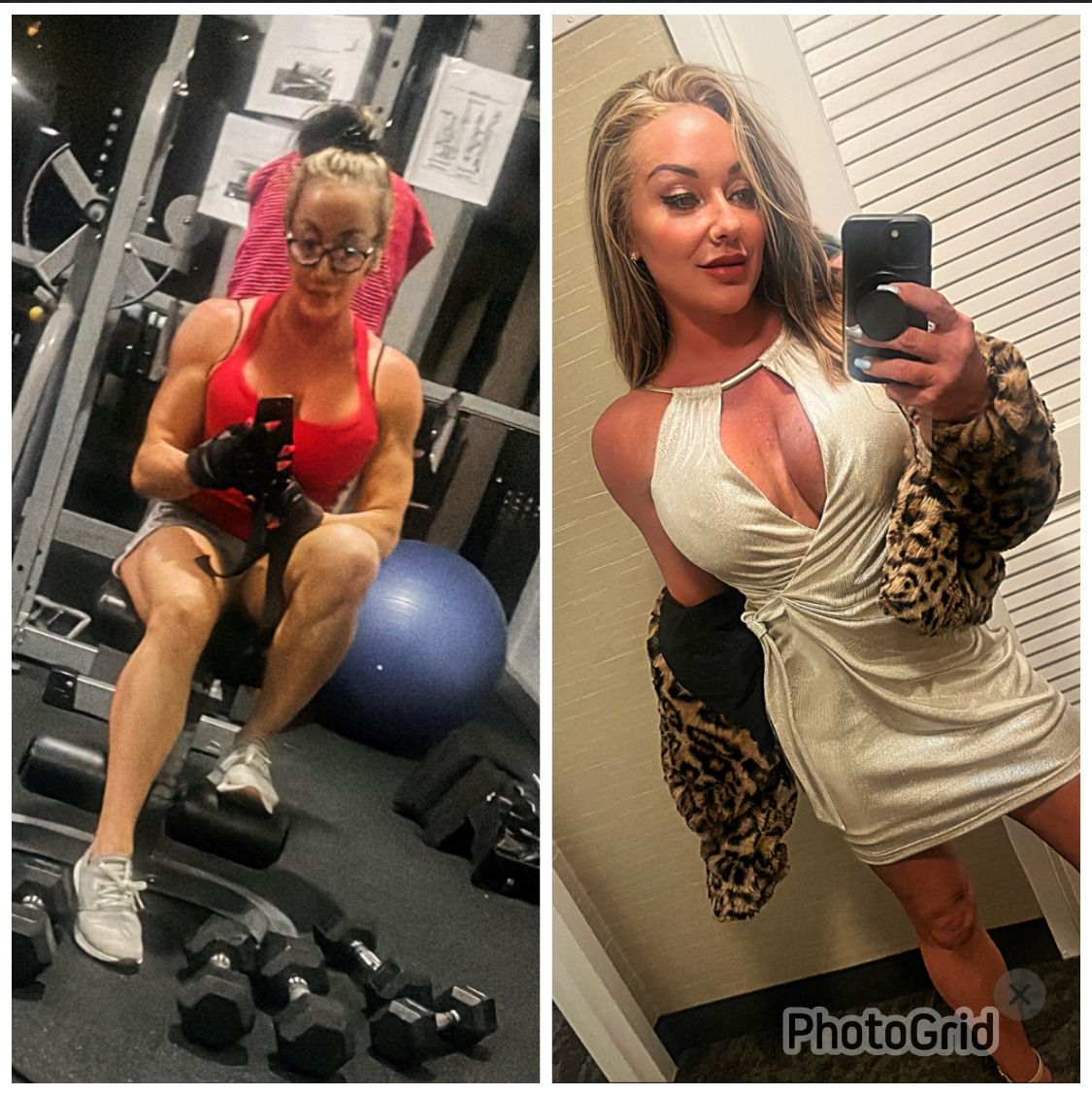
Your weight? Would you please sit on my face?

But I bear zero responsibility for any lip splittery or bruising due to friction or smuffication due to ... well.... the very thing you requested🤭 Promise to resuscitate, tho!
Personally, I have never needed it. First, I rely more on pictures than I would ever on a weight range. And, I typically will find any glaring issues in the details of the review. And weight is not distributed the same accross all women. It's easier for me to see how she fits in her body in a picture than a number.
Once you get into weight, so many assumptions. I have seen less than 100 pound women who look like they are on drugs and simply unattractive. And, I have seen 150+ pound women who look fit and sexy as hell. And, I have seen both 100 pound women who look sexy and 150+ who don't. Meanwhile, I have heard more men yabber about wanting a 100 pound lady over one who weighs more without knowing what the fuck they're talking about.
-- Modified on 12/11/2025 4:09:41 PM
I fail how to see how that vague nothing of a term which can mean anything from a non-chiseled hardbody to a 300+ pound bbw, can be better than an actual numeric range
For the client, that is.
I can definitely see how this numeric range of weight is detrimental to the seller and how vague bullshit is helpful to them.
And imo there's the real crux of the issue. Seller sensitivity to weight and limited desirability of certain weight brackets.
It's like sellers who say they don't post their real age because if they post it less people will see them. Well yeah that's how it's supposed to work, ain't it?
You "fail to see" everything when it comes to females because you are on the spectrum. Your lack of self awareness is off the charts. Once again, if you want providers to participate in the discussions here and have their reviews posted you need to find a good therapist who can work with you so you understand how females think, feel, and function as humans. *YOU* again, are the problem here, not the lack of a box to indicate a provider's weight. Good gawd.
All humans have weight. Men-just like women - are able to evaluate weight of other humans just fine. Just like they can evaluate age, pussy tightness, ethnicity, tattoos, and everything else on ter profiles.
This is a website where men review women they want to fuck. And that should include their weight. Not the weight sellers want to be perceived at. But weight they were when the buyer who wrote the review (or in ter case initial profile) evaluated them.
Sorry, anyone who says "a few extra pounds" is a more accurate representation of a random provider anywhere between 110 pounds and 300 pounds than actual concrete numeric ranges, is the one on the spectrum, not me.
It's not my problem sellers want to be perceived better than they are and get and claim nonsense like men can't gauge weight. Get the fuck outta here.
How about we get a "fat" or "bbw" build at least then? That's part of the problem too ain't it. Providers just don't want to land in unfavorable ranges. Or be called bbw or fat even when they *are* bbw or fat.
Let me break this down for you again. Providers do *NOT* have to be listed on this site to be successful. They can pull their profiles at any time and still do very well in this industry, which a large quantity of providers already have and are very vocal about this on social media.
Now think about this really, really hard. Are the comments and "suggestions" you make helping to get more providers on this site, OR are they making providers not participate and have their profiles pulled? If you continue to make comments and "suggestions" like you do, and all providers finally request to have their profiles pulled, what would be left for this site to operate? If your comments and suggestions cause this site to continue to hemorrhage good providers and for the site to go down, what was accomplished?
So think real long and hard about what your goal is here and the long term goal for this site. For this site to still be up and running and making money there has to be providers that want their profiles listed. How are your comments and "suggestions" going to help that long term goal? You got this!!
People in the spectrum often struggle with seeing someone else’s POV. They can’t seem to grasp that other people may want different things. Rocket seems to take this to the extreme. People will explain their thought process and he will simply not accept it. This is why sometimes you just have to give up. Plenty of people have patiently explained why they think this is a bad idea, but he won’t budge. He can’t grasp why people think his idea is ridiculous. He probably wants us to start bringing scales to appointments.
Yes, you are 100% correct. I actually have an autistic client that I see. He is 25, still lives with his parents, delivers pizza for a living. The difference though is he KNOWS his thought process about almost everything is different. He has been through enough therapy that he can explain a situation and compare how he views it vs. someone that is not on the spectrum. He acknowledges it, accepts it, and is able to openly discuss it. He can see how people that are not on the spectrum would understand and process something vs. how he does. I don't think my client actually possesses the ability to be empathetic, but he also understands this and is open about it and is able to ask questions about how I feel or how others feel in situations. Q has zero self awareness, which is quite sad that he is this far in life without it. It is not about being right or wrong, it is just the basic ability to acknowledge another viewpoint as being valid that is completely lost on him.

My weight during this time of year I refer to as curve season. I eat what I want. I might gain 5 lbs. idgaf 🤪 it’s nostalgia I am honest fun foodie size, but since I am from SoCal I will train hard 2026 to be bikini ready. I set the bar on what it means to be a woman.
Guys are terrible at estimating physical attributes. How many times have you read one review where the guy says she is skinny but the next review says she is average. Or one review says she is all natural breasts but she actually has implants? I've seen reviews where the heights are off, a tall reviewer thinks a 5'8" girl is 5'4".
Weight is so hard to estimate because bone density factors in, muscle mass, even time of the month. Body type is much better indicator, where TER could improve is a visual definition of body types.
I haven't read all of the replies yet, but many. We wouldn't have this problem if TER would follow my frequent suggestion to use IMAGES instead of adjectives. The fashion industry, psychology, and other fields have standard silhouettes that they use to represent major body types. I am posting one such image below.
.
http://www.theeroticreview.com/discussion-boards/suggestion-and-policy-4/use-images-for-better-ids-15747
Use images for better IDs
http://www.theeroticreview.com/discussion-boards/suggestion-and-policy-4/waist-to-hip-ratio-sulhouettes-pantone-color-charts-etc-14295
Waist-to-Hip Ratio Sulhouettes; Pantone Color Charts; etc.
and MANY more such posts on S&P and General.
.
Also, replace "Ethnicity" with two separate fields: (1) Complexion (and use the Barbie color chart from Espresso to Coconut) and (2) something cultural or country of origin (culturally).
.
More of my posts:
http://www.theeroticreview.com/discussion-boards/ter-general-board-12/complexion-chart-vs-cultural-heritage-vs-ethnicity-1023583
http://www.theeroticreview.com/discussion-boards/ter-general-board-12/re-thanks-imp-for-------978675
http://www.theeroticreview.com/discussion-boards/ter-general-board-12/bmi-waist-to-hip-ratio-thumbnails-812001
.
Can't we all just get along?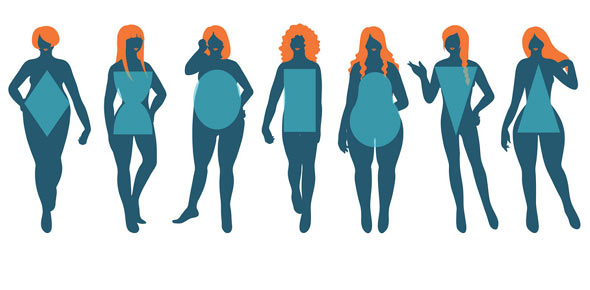
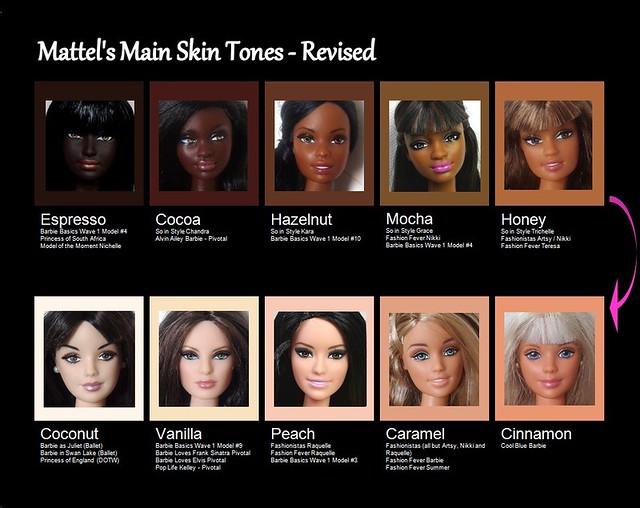
Seriously tho, I think these are great ideas.
In case anyone's wondering, I'm the upside down triangle....or the square. Depends on how much water I'm holding and if I've been focusing on hip thrusts lately.
Complexion-wise, probably Caramel.
BUT WHAT DO I WEIGH‽?😂
Whew! This got funny....
-- Modified on 12/12/2025 6:34:02 PM
My old posts have more details and many other silhouette options. I think the implementation would be image / adjective / radio button:
.
[Image 1] [Image 2] ................ [Image 10]
[Espresso] [Cocoa] ................... [Coconut]
( ) ( ) ....................... ( )
and the reviewer clicks one and only one button.
.
[Image 1] [Image 2] .................. [Image 10]
[Plus size] [Extra Pounds] ......... [Slender] ----------- (Replace these old adjectives with better choices)
( ) ( ) ..................... ( )
and the reviewer doesn't have to pick an adjective -- Thin or slender? Athletic or Muscular? -- but just clicks one and only one button that best matches the appearance ("build") of his hostess.
Seriously tho, I think these are great ideas.
In case anyone's wondering, I'm the upside down triangle....or the square. Depends on how much water I'm holding and if I've been focusing on hip thrusts lately.
Complexion-wise, probably Caramel.
BUT WHAT DO I WEIGH‽?😂
Whew! This got funny....
-- Modified on 12/12/2025 6:34:02 PM
Reading some of the discussion I thought about these old posts. But I suspect even it were implemented some would find something to argue about. Shrug.