
I'm replying to some of crsm's points above (the cost of getting a drug approved) and here (recouping the cost of R&D).
.
Crsm's estimate of $20M to $100M is way too low according to almost every analyst, including the most skeptical ones. On the other hand, only the most fervent Drug Co. supporters believe the Tufts numbers:
http://en.wikipedia.org/wiki/Tufts_Center_for_the_Study_of_Drug_Development
Tufts Center for the Study of Drug Development
.
"The center has published numerous studies estimating the cost of developing new pharmaceutical drugs. In 2001, researchers from the Center estimated that the cost of doing so was $802 million, and in 2014, they released a study estimating that this amount had risen to nearly $2.6 billion. The 2014 study was criticized by Medecins Sans Frontieres, which said it was unreliable because the industry's research and development spending is not made public. Aaron Carroll of the New York Times also criticized the study, saying it "contains a lot of assumptions that tend to favor the pharmaceutical industry." The center's 2016 estimate, published in the Journal of Health Economics, found the cost to have averaged $2.87 billion (in 2013 dollars)." I haven't found their 2024 numbers yet.
.
The patent system is supposed to allow for exclusive rights for a period during which to recover costs (and make a profit and do more R&D for the next new idea). Drugs aren't like a new screwdriver ("RatchetBall") or Apple Watch case (beveled edges versus squared edges - ooooOOOOHHhhhh! What a brilliant and risky idea!!!) You patent a screwdriver on Day 1 and it's being sold in stores in less than a year, exclusively by you for 19 more years. There is little or no safety testing to slow down sales.
.
You patent a drug on Day 1 (to protect the drug itself (the property) so no one else can make it and sell it). It can take 5 or 7 or 10 or 15 years to do all of the testing and clinical trials to satisfy the FDA and get it approved for sale and use. You now have only 5 years (at most) of exclusivity to recoup your costs. (There are rules that allow some extended coverage time.) One argument is to allow a LONGER period of exclusivity to keep the price lower for longer.
.
Other countries allow their Health Care systems to negotiate with the Drug Cos. In the US, Medicare / Medicaid IS NOT ALLOWED AND WAS PREVENTED BY LAW from negotiating lower prices. (Those laws were bought and paid for by the Drug Co. Lobby.) Biden was able to get the Drug Cos. to lower prices on ~30 important drugs.
.
The system needs to be fixed.
I am not sure where Cuban is getting his 15% baseline either.
What I am think is Cuban is only offering it for generics type thing or drugs that past the 10 year patent stranglehold. So the ones that have competition out there. I mean think about it. Viagra was the only dick pill for years... then came Cialis and others. Now you got the China knock offs you can get with a phone call or online type things... your blew chews, red rx, hims, etc.
I was just giving examples of what I think Trump is talking about.... But he is going to do it on a nationwide level. Like make sure Big Pharma splits costs of R&D globally, maybe cut down on the 10 year patent strangle hold for competition, etc. Type things.
.
More to discuss but I've got other stuff to do now.
-- Modified on 7/28/2025 4:01:46 PM
Self explanatory . . .
http://www.youtube.com/shorts/TTzIsrHyEXE
You are posting to TER P&R where a bunch of MAGA cult members DO need an explanation.
.
Let's say a prescription costs $100.
50% of $100 is $50. Reducing the cost of that drug by 50% brings the cost down to (100 - 50) = $50.
A 100% cost reduction is (100 - 100) = $0 = FREE!
.
A 500% cost reduction is (100 - 250) = --$150 means that the pharmacy or drug company will pay you $150 when you receive that Rx.
.
1000% of $100 is $1000. That drug will now cost (100 - 1000) = --$900. You will get $900 from the pharmacy or drug company when you receive that Rx.
.
I wonder how Trump will get drug makers and vendors to agree to that.
I expect the MAGAs will continue to believe Trump's lies and that "Mexico Will Pay!"
Actually you are wrong on what he is talking about. He is talking about what the cost of the drug is to make and the MARK UPS.
If a pill costs $1 to make and they sell it for $100. That is 100% mark up. Now you reduce that by 100% it costs $1... it isn't FREE... it is $1.
Now where Trump is talking out his ass is when he is saying he will REDUCE PRICES by anything over 100%. You are correct on your math on that. His math ain't mathing.
If the DUMB ASS would have just said his plan is to REDUCE MARK UPS OF DRUGS. People wouldn't be calling him an idiot. Because there are those 1000% mark ups. There are pills that cost $1 to produce and selling for $1000 type shit. Where insurance picks up 90% copay or what every and the consumer is stuck with $100 bill.
It is kind of what Mark Cuban is trying to do with his Cost Plus Drugs. Cut out middleman where many mark ups happen.
Going off on a bit of a tangent, but an important tangent. The cost of a pill may be less than $1.00. The cost of DISCOVERING what goes into that pill and getting it APPROVED by the FDA can cost $400M to over $1 B. Clinical trials aren't cheap and frequently fail.
.
Prior to a drug company spending $400 M or more on R&D, there might have been many more $millions spent by the NIH and NIH funded researchers and philanthropies (e.g., Wellcome Trust) to generate a huge body of information to jump start the R&D on a marketable drug.
.
A patent is in force for 20 years. It can take YEARS after getting a patent issued to get FDA approval to sell the drug. Patent protection might be reduced to 5 years to 8 years during which time a company wants to cover its expenses and make a profit. During those 5-8 patent years, a competitor might get a similar or better drug approved. More income and profits disappear.
.
A generic pill mill in India or China can knock off a proven drug for pennies per pill. But they didn't spend anything on R&D.
.
The US citizens deserve a return on their tax investment in NIH research. The drug companies (usually) deserve a return on their $400+ M investment to get the drug approved. But prices do have to be kept *reasonable.*
.
Getting people to agree on "reasonable" (or affordable) is the rub. One argument is to change the law to extend patent protection on drugs to spread out the years available to recover costs and make a profit at a lower cost per pill. (Recoup $500 M over 5 years = $20X per pill. Recoup the same $500 M over 10 or 20 years = $10X per pill or $5X per pill.) And there are many other plans that have been proposed.
.
We probably agree on cases like Daraprim and the Epipen.
.
Daraprim: http://en.wikipedia.org/wiki/Pyrimethamine#Economics Turing Pharm bought the rights to Daraprim and then jacked up the US price from $13.50 to $750 per PILL!!! In non-US countries, Daraprim costs from 2 cents to $1 per pill.
.
Epipen: http://en.wikipedia.org/wiki/Epinephrine_autoinjector#United_States Mylan Pharm bought the rights to Epipen. Heather Bresch, Senator Joe Manchin's daughter, was a low-life CEO who lied about her MBA. Mylan is not an R&D drug company. They just sell existing products obtained from others. Mylan jacked up the price of Epipens by 500%.
http://en.wikipedia.org/wiki/Heather_Bresch
"... The Intercept reported that during an ongoing racketeering case involving Mylan and Bresch, "newly released court documents show [Bresch] discussing a deal with Pfizer to eliminate a chief competitor to EpiPen, clearing the way for major price hikes." The 2010 and 2011 email discussions, unsealed by the judge, showed Bresch's assistant discussing divesting from Adrenaclick after the closure of the Pfizer/King deal. They "also show Bresch approving a scheme to force customers, captured by the company’s monopoly, to purchase two EpiPens at once, regardless of medical need."
.
And there are other examples of such GREED, without even a sham interest in needed cash flow for R&D on new drugs. (The Epipen price gouging enriched Bresch and the other company officers. Bresch was one of the highest paid CEOs in her company category.)
Actually you are wrong on what he is talking about. He is talking about what the cost of the drug is to make and the MARK UPS.
If a pill costs $1 to make and they sell it for $100. That is 100% mark up. Now you reduce that by 100% it costs $1... it isn't FREE... it is $1.
Now where Trump is talking out his ass is when he is saying he will REDUCE PRICES by anything over 100%. You are correct on your math on that. His math ain't mathing.
If the DUMB ASS would have just said his plan is to REDUCE MARK UPS OF DRUGS. People wouldn't be calling him an idiot. Because there are those 1000% mark ups. There are pills that cost $1 to produce and selling for $1000 type shit. Where insurance picks up 90% copay or what every and the consumer is stuck with $100 bill.
It is kind of what Mark Cuban is trying to do with his Cost Plus Drugs. Cut out middleman where many mark ups happen.
-- Modified on 7/25/2025 3:27:08 PM
..,but they’re only recovering their R&D costs from Americans. There’s a brand-name drug that costs $800. for a 30 day supply in the U.S. (not genetic yet). I talked to a friend overseas who told me that the exact same American brand-name drug costs $60/month there.
That’s bullshit to only stick Americans for the R&D costs.
Yes, BP. You are correct. As I am in the US, I also think that the drug companies need to spread the costs around A LOT more. (If I was in the EU, I might favor the status quo: cheap drugs for the EU and let the stupid Americans pay!)
.
And someone else posted about the "middle men" in the US prescription drug supply chain. There are MANY! It isn't just big drug company to (CVS, Walgreens, ...) to patient. There are middle men and wholesalers that jack up prices at every step of the way and who also provide opportunities to steal drugs for the black market or insert illegal cheaper hence more profitable knockoffs with sophisticated (even hologram) counterfeit labeling into the supply chain.
.
Other developed nations (UK, EU, etc.) provide universal health care for their residents. Their health agencies do not always agree with the USA FDA on drug approvals or allowed uses. And they are often MUCH more budget conscious and less prone to cave in to special interests. E.g., once a drug goes off-patent and there are generics available, they will only pay for the cheaper options, not all options.
.
Some drug approvals in the US have been very controversial, especially for rare diseases. Treatments that have shown limited effectiveness in clinical trials can still get approved under pressure from patient advocacy groups, Special Interest Disease Org., their Congressmen, and others. Insurance companies are then forced, by law, to pay for some of these million dollar treatments. Some of the EU health agencies have decided not to pay for some of the questionable treatments (but still allow patients get the treatments by other means: out of their own pocket, charities, 1-on-1 negotiation with the drug companies, etc.).
..,but they’re only recovering their R&D costs from Americans. There’s a brand-name drug that costs $800. for a 30 day supply in the U.S. (not genetic yet). I talked to a friend overseas who told me that the exact same American brand-name drug costs $60/month there.
That’s bullshit to only stick Americans for the R&D costs.
Oh... i do know about all the R&D and what not.
It used to be something like to bring a drug to market was about $20M.... now I think it is about $100M... after all the R&D, trials, etc.
But also one thing sucks about US is that lets say during the trials for a dick pill. They find out it can cure another thing.... say migraines. GUESS WHAT. They have to start back at day 1. They can't start from that point and move forward. That is what SUCKS. So more money needs to go into everything.
But then like you mentioned how Phara is becoming a monopoly and what not.
It is also sad that Hospitals are now more FOR PROFIT than anything. Hospitals will charge people MORE if they have insurance. Make that make sense. Shouldn't it be all the same??? Correct?
…anything and everything Trump barfs out of his mouth.
If the price of drugs are reduced by 100%, they would be free. If they’re reduced 1000%, the drug companies would owe YOU money, lol.
Trump knows as much about math as he does about anything else - NOTHING!
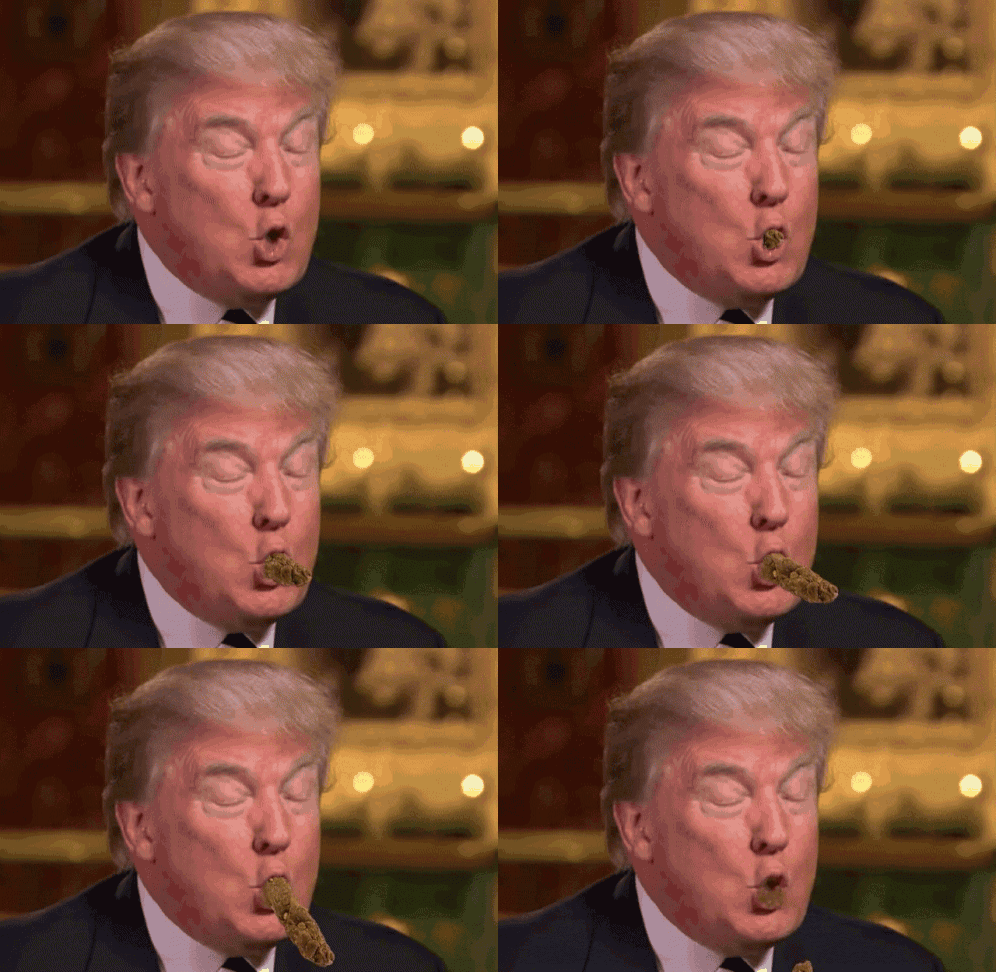
If you have been paying attention. WHICH I KNOW YOU HAVENT.
What Trump is actually wanting to do is something that Mark Cuban has been trying to push. It is cutting out the middle man and the mark up that pharmacies do. Which was made into law under the ACA.
NOW you will see take 1000% or 1500% credit for it... and not give any credit to Cuban or his concept he is and has been implementing. Cuban is only having a base 15% mark up on all drugs. Trump wants same thing..... but then to go FURTHER by getting more generics, not allowing the strangle hold big pharma has on things, etc. Which is dealing with trade and what not....IE: meds produced in other countries type thing. Go look at what certain meds cost in Mexico, UK, Canada, etc. Compared to USA.
But you are correct and the criticism is needed. HIS MATH AINT MATHING. Some drugs are marked up 500%.... like if a pill only costs $1 to produce they sell it for $500. That is a 500% mark up. Same goes for $1000 drug/treatments. GET IT. But it is typical Trump. Like I have stated in another post. He has his Ego and needs to exaggerate everything.
You haven't addressed the BASE PRICE which is set by the Drug Co.. I.e., a 15% mark-up on what base price?
I don't know where Cuban is getting his drugs: direct from the Drug Co or from one of the numerous "middle men" wholesalers / shippers / warehousers.
.
We could also go into the economics of scale and markups. Suppose Cuban (or anyone) only sells cheap-o drugs at a base price of $100 per Rx-year and charges $115 for it. That could be a lot of staff, overhead, warehousing, processing, shipping, billing. 100,000 Rxs x $15 markup = $1.5 M markup.
.
Suppose Cuban (or anyone) sells Wonder Drug at a base price of $100,000 per Rx-year and charges $115,000 for each. He only needs to process, ship, ... 100 Rxs to reap $1.5 M in profit (markup). He only needs to pay for 1/1000 the staff, warehouse space, bottles and caps, FedEx envelopes, ... to process 1/1000 the number of pills to make the same $1.5 M in "markup" = more PROFIT on that markup.
.
Cuban knows math. I think he knows which is more PROFITABLE to sell.
.
I've heard about Cuban's pharmacy company but haven't read a lot of detail. Personally, I want to keep my neighborhood pharmacists close by. In the past 10 years, I've had two "emergency" issues that required me to take some Rx drugs (an strong anti-inflammatory to treat a wound and an specific antibiotic to treat an infected wound). I did NOT want to wait until I got home to order on-line and then wait one or two days to receive some emergency meds that I needed "immediately" and I might not even get from my mailbox until returning home from work in the evening (almost 3 days delay to start treatment).
I am not sure where Cuban is getting his 15% baseline either.
What I am think is Cuban is only offering it for generics type thing or drugs that past the 10 year patent stranglehold. So the ones that have competition out there. I mean think about it. Viagra was the only dick pill for years... then came Cialis and others. Now you got the China knock offs you can get with a phone call or online type things... your blew chews, red rx, hims, etc.
I was just giving examples of what I think Trump is talking about.... But he is going to do it on a nationwide level. Like make sure Big Pharma splits costs of R&D globally, maybe cut down on the 10 year patent strangle hold for competition, etc. Type things.
I'm replying to some of crsm's points above (the cost of getting a drug approved) and here (recouping the cost of R&D).
.
Crsm's estimate of $20M to $100M is way too low according to almost every analyst, including the most skeptical ones. On the other hand, only the most fervent Drug Co. supporters believe the Tufts numbers:
http://en.wikipedia.org/wiki/Tufts_Center_for_the_Study_of_Drug_Development
Tufts Center for the Study of Drug Development
.
"The center has published numerous studies estimating the cost of developing new pharmaceutical drugs. In 2001, researchers from the Center estimated that the cost of doing so was $802 million, and in 2014, they released a study estimating that this amount had risen to nearly $2.6 billion. The 2014 study was criticized by Medecins Sans Frontieres, which said it was unreliable because the industry's research and development spending is not made public. Aaron Carroll of the New York Times also criticized the study, saying it "contains a lot of assumptions that tend to favor the pharmaceutical industry." The center's 2016 estimate, published in the Journal of Health Economics, found the cost to have averaged $2.87 billion (in 2013 dollars)." I haven't found their 2024 numbers yet.
.
The patent system is supposed to allow for exclusive rights for a period during which to recover costs (and make a profit and do more R&D for the next new idea). Drugs aren't like a new screwdriver ("RatchetBall") or Apple Watch case (beveled edges versus squared edges - ooooOOOOHHhhhh! What a brilliant and risky idea!!!) You patent a screwdriver on Day 1 and it's being sold in stores in less than a year, exclusively by you for 19 more years. There is little or no safety testing to slow down sales.
.
You patent a drug on Day 1 (to protect the drug itself (the property) so no one else can make it and sell it). It can take 5 or 7 or 10 or 15 years to do all of the testing and clinical trials to satisfy the FDA and get it approved for sale and use. You now have only 5 years (at most) of exclusivity to recoup your costs. (There are rules that allow some extended coverage time.) One argument is to allow a LONGER period of exclusivity to keep the price lower for longer.
.
Other countries allow their Health Care systems to negotiate with the Drug Cos. In the US, Medicare / Medicaid IS NOT ALLOWED AND WAS PREVENTED BY LAW from negotiating lower prices. (Those laws were bought and paid for by the Drug Co. Lobby.) Biden was able to get the Drug Cos. to lower prices on ~30 important drugs.
.
The system needs to be fixed.
I am not sure where Cuban is getting his 15% baseline either.
What I am think is Cuban is only offering it for generics type thing or drugs that past the 10 year patent stranglehold. So the ones that have competition out there. I mean think about it. Viagra was the only dick pill for years... then came Cialis and others. Now you got the China knock offs you can get with a phone call or online type things... your blew chews, red rx, hims, etc.
I was just giving examples of what I think Trump is talking about.... But he is going to do it on a nationwide level. Like make sure Big Pharma splits costs of R&D globally, maybe cut down on the 10 year patent strangle hold for competition, etc. Type things.
.
More to discuss but I've got other stuff to do now.
-- Modified on 7/28/2025 4:01:46 PM
Agree on much of what you stated.... and my numbers were off. I just remember hearing these things from a friend of mine who was in the Pharma sales 20 years ago.... so yeah my numbers are LOW AS FUCK.
Also I totally understand about Capitalism and they deserve to get money back for R&D.
But lots of the fuck up about regulations is the fact like I mentioned about if they are studying or developing a drug for one thing. But then find out it can help in another area. They have to start from scratch in that other area. They can't start from that point in the R&D. Even though they already did the early bullshit. It is a waste of time, money, etc. Which again boosts costs on that "new" discovery. It is Gov regulations getting in the way of innovation.
Also on the comments about negotiation of drug prices. That is a huge fuck up of the system. Which also pushes the burden of that "public" type of medical care negotiation (Medicaid/Medicare) on drugs onto private insurance companies. Which will inflate premiums for people on those plans.
YOu are 100% correct it is the lobby game that is fucking everyone over when it comes to Big pharma and medical supply/device industry. Even the hospital lobby. Trust me hospitals are not innocent in all of this either when it comes to pricing and fucking over insurance companies and people. Insurance companies are not always the bad guys. They are not always innocent either. But that is a different subject/topic.
But back to what I believe Trump and Cuban are trying to do is the whole mark up on drugs. They are trying to some how kill that or cut that down. I have no clue how. But that is what they are talking about. Does that have something to do with these trade deals? Who knows? I do know last time Trump was in office he made deals with the new "NAFTA" that allowed certain generics into the US market earlier and what not. So now is this something over seas markets.... Who knows? Time will tell.
I think that we are going to agree A LOT on some things and disagree A LOT on some other things.
http://en.wikipedia.org/wiki/Drug_repositioning Depending on the drug and disease, it is NOT as easy as writing an Rx for the new application. (See wiki.)
.
The Gov regulations are NOT there to stifle innovation, they are there to protect THE PUBLIC from harm. See my post about the roots of the FDA in 1906:
http://www.theeroticreview.com/discussion-boards/politics-and-religion-39/food-and-cosmetics-463707
(Scroll down to ...) "Upton Sinclair wrote The Jungle about the meatpacking industry in 1906. It helped lead to reforms and gov regulations to protect the public. http://en.wikipedia.org/wiki/The_Jungle#Federal_response "After reading The Jungle, [Theodore] Roosevelt agreed with some of Sinclair's conclusions. The president wrote "radical action must be taken to do away with the efforts of arrogant and selfish greed on the part of the capitalist." MANY additional efforts have been made since then and there is always industry resistance to regulations. Some things never change."
.
I would add the regulations can SPUR innovation into high gear! "No more toxic ethylene glycol in cough syrup." means that innovators had to come up with new ingredients and new formulations. (Not drugs, but) "No more gas guzzlers!" got the automobile industry to innovate and get fuel efficiency up from 8 MPG to 40+ MPG.
.
Back to drugs ... Several drugs for diabetes have been repurposed WITH FDA APPROVAL for weight loss. I think that happened fairly quickly.
http://en.wikipedia.org/wiki/Anti-obesity_medication
Look at the list for drugs that were once Approved but were subsequently Withdrawn because the FDA determined that they were UNSAFE for that purpose or totally unsafe.
http://en.wikipedia.org/wiki/United_States–Mexico–Canada_Agreement#Provisions
"USMCA provides for a patent term extension where there is an "unreasonable curtailment" of a pharmaceutical's patent term stemming from delays in the regulatory or marketing approval process.
.
"USMCA accounts for data exclusivity of new pharmaceutical products. New pharmaceutical products are those that do not contain a chemical entity that has been previously approved by that party.[1] Generic manufacturers are prohibited from relying on the innovator's previously undisclosed safety/efficacy testing for at least five years from the date marketing approval was first granted. Mexico agreed to extend its data protection of new pharmaceutical products.[67] Canada's data protection regime already offered an eight-year exclusivity period for innovative drugs and thus was not required to make changes. ..."
.
Trump makes many false claims about, well, everything, including drug pricing:
http://www.cnn.com/2024/06/14/politics/fact-check-trump-biden-insulin-costs
Fact check: Trump falsely claims Biden didn’t lower Americans’ insulin costs.
.
If you've got some specific references (links) to the USMCA and lower drug prices, please post them.
NAFTA 2.0 with drug prices was with Canada and some generics or something. IT was what we are talking about with the length of the patent and what not. Can't remember but it cut down on the years or what ever. It did something.... not a whole hell of a lot... but did do it.
Like I have mentioned... right about then you noticed the "over the counter" type dick pills. The blue chews, hims, etc. type stuff popping up. Before you couldn't do that stuff.... via phone, online, etc.
Now with the whole rebranding/redirection of drugs and R&D. You bring up the weight loss with diabetic meds. Those things were not "quickly" brought to market. They did take years to do it. I also understand about safety and what not.
But what I am getting at that even though lets say a drug went thru basic testing for XYZ and gets to a point and they find it has other benefits. Now that they want to possibly go in that direction for those new benefits.... they have to start back over... with the same formula and test again for XYZ because they decided to take it in the new direction for those new benefits. EVEN THOUGH they just did those tests. It is REPEATING when they dont need to. That is what I am getting at. They didn't change the formula. They didn't change a damn thing. But they are made to RESTART the process all over again with the basic starter tests.
Now onto insurance.... Yes Insurance Industry has its issues.....ie denying claims and what not. Also many don't understand about the whole experimental drug vs other things. Which is sad when dealing with life or loss of life. But two things people dont understand IF insurance companies were to do those things at any costs necessary. Nobody could afford insurance... NOT EVEN THE US GOVERNMENT. Under a "national" healthcare people wouldn't get those "experimental" type drugs they would get "comfort care" type situations until they passed. It is the sad and cold truth.
You could bring up... WELL THE GOV COULD REGULATE IT.....there are still costs on top of costs. Who will be paying those costs?
But remember insurance premiums are based on costs or what hospitals, pharma, etc charge. So when people complain about PREMIUMS..... it is on hospitals, pharma, medical device, etc costs. If you don't believe me... right now you are only a # to most hospitals. That is it. Hospital employs or are hiring more people who DONT SEE PATIENTS than people who do. More number crunchers, paper pushers, HR personnel, etc. Then Doctors, nurses, and even receptionists.
If you want to get into CEO's HUGE bonus. Well they get them because of negotiations.... with hospitals for pricings or like said negotiations with pharma to a certain extent. Those CEO's and their teams will get the data and find out Mayo Clinic does 100K knee surgeries a year for an age group and charge X amount in 2023. So in 2024 Mayo wanted to increase by 20%... the CEO's negotiate that increase (possibly a decrease). Lets say it is only a 10% increase. Now that insurance company raises the premium (by law they can) with in that age group accordingly for that increase. Now the next year they do only 95K knee surgeries with Mayo.... A portion of that 5K less unused premium increase gets kicked back to insureds (VIA ACA regulations)..... and a portion of that gets a BONUS to the CEO. That CEO does many of these negotiations with other hospitals. That is how they get HUGE BONUSES. Simple example with those knee surgeries... lets say they negotiated that Mayo could only raise it $2K instead of $3K... that is $1K savings... that is $100M savings for the insurance company if they do the full 100K surgeries. With my example.
Nevertheless.... it is a fucked up system. A national system wont work. We as a nation are too lazy, too unhealthy, and too self centered and greedy. The system set up now isn't working because.... we as a nation are too lazy, unhealthy, self centered, and greedy.... yeah.
Just a few comments for now ...
.
After many man-years of people taking the drugs, the FDA knew a lot about side effects (weight loss!) and approvals for prescribing for weight loss only took from 4 (for the first ones) down to just one year. (And I think that one or more are now OTC for weight loss.)
2. What do you mean by "experimental"? Drugs that are not yet approved but are going thru clinical trials?
3. Most other developed countries set a BUDGET first, and then allocate that budget according to various considerations. The US passes laws that MANDATE certain kinds of care -- "Everyone has a right to a double lung transplant" -- and THEN tries to figure out how to budget for it.
4. "Under a national healthcare ... "experimental" type drugs": What are you talking about? There are rules and regs for Compassionate Use and other sorts of use of experimental drugs. It is NOT automatic. Drug companies are not allowed to charge for Compassionate Use. Drug companies may not cut off compassionate use and must continue to provide the patient with the drug even if the drug was not approved for general use. ("Drug failed in 398 patients. Worked in two patients, both continue to receive the drug under Compassionate Use.")
5. And more Qs.
http://www.theeroticreview.com/discussion-boards/politics-and-religion-39/re-we-have-the-worst-of-both-worlds-468575
.
Simplified, our health care system takes in ~$5 T in payments: Medicare, Medicaid, Insurance Premiums, Co-pays, out of pocket expenses, We will continue to pay in ~$5 T by the usual means or minor variations thereof. Around $4 T goes to the delivery of actual health care (which includes hospital support staff: receptionists, janitors, etc. AND doctors, nurses, etc.) . $1 T is skimmed off the top to pay insurance companies, their C-Suite, their investors, etc.. GET RID of the middlemen and insurance companies and you will get $5 T of health care from $5 T paid in or you can lower premiums or expand services.
Nevertheless.... it is a fucked up system. A national system wont work. We as a nation are too lazy, too unhealthy, and too self centered and greedy. The system set up now isn't working because.... we as a nation are too lazy, unhealthy, self centered, and greedy.... yeah.
-- Modified on 7/30/2025 12:12:37 PM
I should have been a little more clear when I meant with "experimental".
It is stuff that is approved. I should have said "radical". Or like a treatment that is "last resort" not typically done, Etc.
You talk about budget and my wording of "experimental"....
how do you "budget" or draw the line at things? That is the issue and what happens in a national system or single payer.... and same goes for private insurance (unless paid for via premium and plan choice). The difference is private insurance YOU CAN PAY for the coverage if you choose to. LIke buy the supplement, pay for the extra coverage, higher limits, etc. Single payer you can't. You are stuck with what they tell you or set for you..... or what they budget for you.
What will happen and what does happen in a single payer. Is they have a "check list" type or a game plan/budget they follow. You get diagnosed with something. You have step 1, 2, 3 for treatment or surgery... then if those don't work... well they will make you comfortable. They can't BUDGET for every person in the country or the "what ifs". The "radical" treatment or "last resort" wont be an option unless you want to pay out of pocket or go into a "study".... if they even give you that option. With private if your plan or coverage allows it, you can keep going. Some insurance companies do work with trials with PHARMA and get you in on them for "radical" treatments..... so do hospitals and they work with your insurance as well. The reason why is because you already paid for it or they have "budgeted" for it with the paid in premiums or co-ops with Pharma... (that CEO's negotiate and get bonuses for if those drugs hit it big)
Now your mentioning of the combination of the single payer and private offering supplemental could work. But the issue would be.... how do you divvy it up? What is considered "basic"? You brought double lung transplant... is that basic? Are some elective surgeries "basic" or will be voted into becoming "basic"? You know boob jobs, Lasik eye surgery, trans surgeries, etc....(think of political climate right now). Will now every citizen be required to get a physical?
I agree a combo would work. A revamping of what we got could work. The real issue is you can never cover for all situations and Congress would try to cover for every situation possible just to get votes.
In another response on this thread. I mention single payers are great for smaller population countries and smaller in size geographical countries as well. Where people are in close proximity to hospitals and what not. Highly population density areas it would work. Low population density is doesn't as well. So people would lose care and resources.... is that fair if they get taxed the same? Should they get penalized?
analysis from the right-leaning guys here, Trump's using a version of hooker math on the numbers he is touting. Prices can go up by 500% or 1000%, but they can't go down more than 100%, because at that point, you reach zero. So, claiming they will go DOWN 1000% is at least negligently misleading to the public. He was reading a speech written by a staffer, so there is no way to know if Trump saw this ahead of reading it out loud for the news media.
Trump may be good at construction math, but he's not good as pharmaceutical math. Lol
Trump's staffers cringe whenever he decides to go off script to "wing it". I'm sure Chief of Staff Susie Wiles pulls her hair out whenever it happens.
Trump has a proven track record of being TERRIBLE at construction math. BY HIS OWN ADMISSION, he overpays for real estate. (He admitted overpaying for the Park Plaza, Eastern Shuttle [that he "reconstructed" and never had a profitable month], and the DC Post Office Hotel lease ... that other hotel professionals said could never be profitable at that valuation AND THEY WERE RIGHT! Trump made possibly illegal transfers of money from Trump Org to the Post Office Hotel in order to HIDE the fact that the Post Office Hotel lost $70 M in the first three years of operation.)
.
Then, Trump overspends on renovations and "improvements" (that are not improvements but add expense and decrease revenue and lower the value of the property). He has defaulted on numerous real estate loans (with more coming due very soon).
.
His employees and advisors (professional construction engineers) describe Trump as being unlearned and unteachable regarding his construction projects. He spends most of his time making important decisions about the color schemes for the furniture.
.
He originally wanted to build a 2000 mile long Big, Beautiful border wall out of reinforced concrete or brick -- he kept changing the story.
Trump is a construction moron.
-- Modified on 7/31/2025 5:48:06 AM