Politics and Religion

Biden’s Hurricane Katrina.
Hpygolky 234 Reviews 83 reads
posted
1 / 25

Affected by wild fires, And this isn't the first he's pulled that shit. In 2018 with the Northern California fire he threaten the same thing, so trump can for fuck himself. And anyone would who would put politics over a disaster is a POS. You don't fuck with disaster relief
And you're following another twitter hoax.President Biden, has approved Major Disaster Declaration for North Carolina and it will  continue.Along with Florida, who Desantis has fuck that up with some homes not being insured. That's another story.
But imagine if you live in tornado ally, or hurricane Florida and Biden threaten to hold back funding...now that's something you would shit your pants over...
And that's why I trust Harris when a disaster hit.

LostSon 43 Reviews 77 reads
posted
2 / 25

B U T  T R U M P ! ! ! 😥 😥 😥

This situation is astoundingly bad and all you can do is whine about Trump?  

You are NOT Happy.

BigPapasan 3 Reviews 72 reads
posted
3 / 25

...subject of Biden and FEMA so comparison to Trump and FEMA is quite appropriate.

 
"During his presidency, Donald Trump failed in both the preparation and disaster response to hurricanes, storms, and flooding and actively worsened conditions for Americans impacted by such weather events.  

 
He failed to adequately prepare the country for hurricanes by leaving disaster response positions open months into his term.  After Trump’s FEMA botched the response to Hurricane Maria, Trump downplayed the suffering, claiming it was not a 'real catastrophe like Katrina.'  After Hurricane Harvey took 88 lives and caused $130 billion in damage in Texas, Trump joked that the state made a 'fortune.'  

 
Trump also rolled back critical flood protections that protected Americans from rising sea levels. During Trump’s term, the U.S. saw five billion-dollar flooding events that caused $28.5 billion in damages and killed 37 people."
http://climatepower.us/research-polling/trumps-failures-on-hurricanes-storms-and-flooding/

inicky46 61 Reviews 68 reads
posted
4 / 25

Biden immediately signed an emergency declaration for NC and other states. Go fuck yourself, you lying Wanker.

Hpygolky 234 Reviews 68 reads
posted
6 / 25

Emergency crews probably can’t get to the area.
But I know you WANT to blame Biden

nunya_buisness 80 reads
posted
8 / 25

It seems like you accidentally linked the wrong article.  
The one you provided actually discusses how urbanization and island building (through dredging) in South Asian islands is offsetting erosion. This doesn’t directly support your claim about ocean coastlines growing overall due to natural processes.


At the same time, significant
human-driven factors influencing the seaward expansion of island shorelines encompass urban
growth, the vigorous development of port economies, and the increase in aquaculture activities.
Contrary to initial assumptions, our empirical data does not conclusively link the widespread
erosion of island shorelines primarily to historical sea-level rise, suggesting that human activities
might mask the effects of sea-level rise. Based on a thorough analysis of current data and consideration of future sea-level scenarios, we believe that sea-level rise will continue to pose a significant
challenge to island communities and recommend these communities to adopt scientifically validated strategies as these could be crucial for their sustainable survival and development
Let’s address the idea that ocean coastlines have grown overall. While some coastal areas have indeed experienced land gain due to sediment deposition or human activities like dredging and land reclamation, this doesn’t reflect the global reality. According to numerous studies and reports, including those from the Intergovernmental Panel on Climate Change (IPCC), rising sea levels driven by climate change are leading to more coastal erosion, and many low-lying areas are at increasing risk of submersion.

In fact, while some areas have seen land gain, the broader trend is that many coastlines are eroding due to the rising sea levels, which are primarily caused by the thermal expansion of seawater and melting ice sheets. So, your assertion about coastlines growing is misleading without addressing these global impacts.

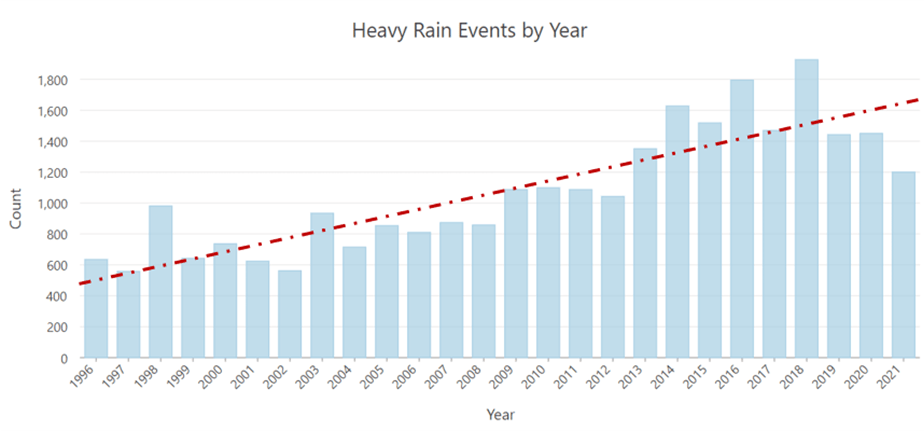
As for floods not being caused by climate change, this claim oversimplifies a complex issue. Climate change contributes to more intense and frequent extreme weather events, including heavy rainfall, which exacerbates flooding in many regions. To investigate these trends yourself, you can look to historic data available in the NOAA Storm Events Database a comprehensive account of U.S. severe weather. Since 1996, the number of heavy rainstorms has increased by about 44 events per year.  Nine of the top 10 years for extreme one-day precipitation events have occurred since 1995  

Scientists have consistently linked climate change to shifts in precipitation patterns, with many areas experiencing more extreme and unpredictable rainfall.  While it's common to associate heat with dryness (like droughts), increased heat actually leads to more evaporation, especially when it involves warmer oceans. Hotter air can hold more moisture, resulting in heavier rainfall. It's like the water cycle on overdrive, with water evaporating and being dumped at a much faster pace. This hyped-up hydrologic system culminates with 93% of land surface getting more rain compared to historic baselines.

nunya_buisness 79 reads
posted
9 / 25

Global temperatures have undeniably risen, and to claim otherwise is to ignore overwhelming scientific data. According to the NOAA Annual Global Climate Report (2021), the combined land and ocean temperature has increased at an average rate of 0.18°C (0.32°F) per decade since 1981. As of 2020, global temperatures were 1.02°C (1.84°F) above the 20th-century average, with 2020 being one of the hottest years on record, just behind 2016. The years 2015-2020 all rank among the six hottest years since records began in 1880.
   
Furthermore, Greenland and Antarctica are losing ice at an accelerating pace. The Greenland Ice Sheet is losing about 286 gigatons of ice per year, which alone accounts for a sea-level rise of 0.77 mm per year. A study published in Nature in 2020 shows that Greenland lost 3.8 trillion tons of ice between 1992 and 2018, while Antarctica lost 2.5 trillion tons during the same period. The Antarctic Ice Sheet is losing ice at a rate of 148 gigatons per year, contributing to a global sea level rise of approximately 0.4 mm per year.  This data is corroborated by NASA’s GRACE (Gravity Recovery and Climate Experiment) satellites, which provide consistent evidence of ice loss. The IPCC (Intergovernmental Panel on Climate Change) also projects that if emissions continue at their current pace, global sea levels could rise by 0.61 to 1.10 meters by 2100.  According to the IPCC Special Report on Extreme Events (2019), the frequency of heavy precipitation events has increased significantly in most regions of the world. For every 1°C rise in global temperature, the atmosphere can hold about 7% more water vapor. This increase in moisture leads to heavier rainfall during storms. For example, the 2017 Hurricane Harvey dumped 50 inches of rain over parts of Texas, making it the wettest hurricane on record in the U.S., with its intensity amplified by warmer sea surface temperatures. Harvey caused $125 billion in damages, according to the National Hurricane Center.
   
Furthermore, heatwaves are now more frequent and severe. A 2018 study published in Environmental Research Letters shows that Europe has experienced a twofold increase in the frequency of heatwaves since 1950. The 2019 European heatwave broke temperature records across multiple countries, with France hitting an all-time high of 45.9°C (114.6°F). A 2020 World Weather Attribution study linked this directly to climate change, estimating that human activity made the heatwave at least five times more likely.
   
Your false claim that extreme weather events, including hurricanes, are declining is factually incorrect. According to the NOAA National Centers for Environmental Information (NCEI), 2020 was the most active Atlantic hurricane season on record, with 30 named storms, including 12 that made landfall in the continental U.S.. This broke the previous record of 28 storms in 2005. The intensity of hurricanes has also increased. A study published in PNAS (Proceedings of the National Academy of Sciences) in 2020 shows that the proportion of Category 4 and 5 hurricanes has increased by 25-30% over the past 40 years due to rising sea surface temperatures, fueled by climate change. A separate study in Nature Communications found that between 1979 and 2017, tropical cyclones globally slowed by 10%, which means they linger longer over land, causing more damage. For example, Hurricane Harvey in 2017 stalled over Texas for several days, dumping unprecedented amounts of rainfall.
   
While it’s true that we have more comprehensive data collection in the modern era, that doesn't change the reality of long-term trends; in fact, historical data is required when evaluating climates. Data collection improvements have allowed for greater accuracy in comparing past and present conditions, but scientists use standardized methods to adjust for differences in historical data. The idea that modern data collection somehow inflates the observed trends in climate change is misleading.  For example, NOAA’s Climate Extremes Index (CEI), which tracks the frequency of extreme weather events in the U.S., shows a significant upward trend since 1910. The Global Climate Extremes Index (GCEI), which covers global weather extremes, reports that the combined frequency of extreme heat, drought, and precipitation events has risen by about 50% over the past century. These figures are consistent with both historical and modern data collection methods.
   
The claim that "CO2 emissions do not cause climate change" is in direct opposition to the overwhelming consensus of climate scientists. CO2 is a well-documented greenhouse gas, and its role in trapping heat in the Earth’s atmosphere has been understood since the late 19th century. The Keeling Curve, a measure of atmospheric CO2 concentration, shows a clear increase from 315 parts per million (ppm) in 1958 to over 420 ppm today.  Studies published in leading journals like Nature and Science have repeatedly confirmed that CO2 is the primary driver of recent global warming. A 2014 study published in Environmental Research Letters analyzed over 11,000 peer-reviewed scientific papers on climate change and found that 97% of climate scientists agree that human activities, particularly the burning of fossil fuels, are responsible for recent warming trends. Moreover, according to the IPCC Fifth Assessment Report, human activity is responsible for more than 95% of the observed warming since 1950. The CO2 increase is directly linked to the enhanced greenhouse effect, which traps more heat in the atmosphere, resulting in rising global temperatures.
   
The weak argument that climate change is "unfalsifiable" misunderstands how science works. Climate change is a falsifiable hypothesis that has been tested and confirmed by multiple independent lines of evidence. Climate models, for example, make predictions about how temperatures, sea levels, and weather patterns will change in response to increasing greenhouse gases. These predictions are then tested against real-world observations. For instance, climate models predicted that polar amplification (the phenomenon where the Arctic warms faster than the rest of the planet) would occur as a result of rising CO2 levels. Observations over the past few decades have confirmed this prediction, with the Arctic warming at roughly twice the rate of the global average. Moreover, regional differences in the effects of climate change (e.g., more rainfall in some areas, less in others) do not make the science unfalsifiable—they are predicted outcomes based on the complexity of the Earth’s climate system. The IPCC’s Fifth Assessment Report clearly outlines how different regions will experience different climate impacts due to varying geographic and atmospheric conditions. This variability is a known and expected outcome of global climate change.
     
To summarize, your claims about global temperatures, extreme weather, CO2 emissions, and the nature of climate science are not supported by the evidence. Global temperatures have risen significantly, ice sheets are melting at an accelerating pace, and the intensity and frequency of extreme weather events, including hurricanes and heatwaves, are increasing. CO2 emissions are the primary driver of recent climate change, as confirmed by thousands of scientific studies. Finally, climate science is based on testable hypotheses that are continually validated by real-world data.
   
By ignoring this evidence, you’re dismissing the vast body of scientific research that supports these conclusions. Dismissing these trends is not just a rejection of climate science; it’s a rejection of empirical evidence.

Hpygolky 234 Reviews 65 reads
posted
10 / 25

I doubt very much he has a cousin in NC who's stuck.
My thinking is, if I was stuck anywhere and willy was my cousin...shit he'd be the last person I'd call.
Willy is caught up in twitter zone where these stories are flooding the site....Fuck You Elon

Hpygolky 234 Reviews 76 reads
posted
11 / 25
RespectfulRobert 78 reads
posted
12 / 25

Fact A: There is more CO2 in our atmosphere today than last year, and the year before that, and the year before that. 
  
Fact B: What happens when you put more CO2 in to our atmosphere? It heats up.
.
Sound familiar?
.
http://www.theeroticreview.com/discussion-boards/politics-and-religion-39/lets-review-the-scientific-method-for-tim--228002?frmSearch=1#228002

-- Modified on 9/30/2024 5:17:56 PM

RespectfulRobert 78 reads
posted
13 / 25
RespectfulRobert 77 reads
posted
14 / 25

You said it was FACT back then. And now you are spewing these new "facts." Facts don't change Willy. Political hacks manipulate them and you are busted doing so. You're welcome.

Hpygolky 234 Reviews 73 reads
posted
15 / 25

When NC got 1% of what they ask for from Trump .  
That was a major FUCK YOU to your “cousin”,

Hpygolky 234 Reviews 77 reads
posted
16 / 25

Suppose your "cousin" was stuck and she needed first responders like ASAP. But they couldn't get to her because they had to provide security and to a photo op for the Orange Fat Fuck...How would that work for you..
And why isn't she hooked to Elon's Starlink? It easy communication....You'll have up to date communication, on line...C'mon now.
I'm beginning to wonder about your...."Cousin"

LostSon 43 Reviews 70 reads
posted
17 / 25

Posted By: Hpygolky
Re: Hey Willy I got another one for your "Cousin"...
Suppose your "cousin" was stuck and she needed first responders like ASAP. But they couldn't get to her because they had to provide security and to a photo op for the Orange Fat Fuck...How would that work for you..  
 And why isn't she hooked to Elon's Starlink? It easy communication....You'll have up to date communication, on line...C'mon now.  
 I'm beginning to wonder about your...."Cousin"
Suppose… not happy wasn’t soooo Trump Deranged that all he could see or do was regergitate the blue 🥶 gooo like a good little lefty?  

Btw, Love how Joe Joe couldn’t make a statement till Monday. I guess the 10 Am - 4 pm rule REALLY APPLIES? That or it took them till Monday to get his drug cocktail twreaked just right 🤣🤣

nunya_buisness 66 reads
posted
18 / 25

It's unfortunate that you feel the need to resort to name-calling and insults, as this reveals more about your insecurities than it does about the strength of your arguments. Personal attacks weaken your position and distract from serious discussion on the overwhelming evidence surrounding climate change. You cite an article claiming that Earth is the "coldest it’s been in 485 million years," but this is misleading. While Earth’s temperature has fluctuated over geological time scales, comparing today’s climate to periods like the Cambrian or Ordovician, when life and continental configurations were vastly different, ignores the real issue. The point isn’t whether Earth was warmer millions of years ago but that global temperatures today are rising rapidly and unnaturally due to human activity. Of course, the Earth is cooler now than when it was a molten ball of magma; no one is disputing that. The fact that you think this is a solid argument highlights a flawed understanding of climate science. We are in the Holocene epoch, which began about 11,700 years ago, a period that has been relatively stable, allowing civilization to develop. However, since the Industrial Revolution (~1850), Earth’s average global temperature has risen by 1.2°C (2.2°F), driven by fossil fuels and CO2 emissions. Comparing today’s climate to earlier geological periods distracts from the fact that, in the last 150 years, we’ve seen an unprecedented spike in temperatures. According to NOAA, the last decade (2011-2020) was the hottest on record, and 2020 tied with 2016 as the hottest year globally. NASA reports that today’s rate of warming is ten times faster than the average ice-age recovery, proving today’s changes are not natural. In 2019, global temperature was 1.1°C above pre-industrial levels, and in 2020, it was 1.02°C above the 20th-century average, making it one of the hottest years ever. Five of the six hottest years on record occurred between 2015 and 2020. The rapid warming we see today, driven by human activity, is far outside the natural variations of the Holocene.

Your comparisons to the Dust Bowl of the 1920s and the Medieval Warm Period (900-1300 AD) are flawed. The Dust Bowl was a regional environmental disaster caused by drought and poor land management, not global warming. While temperatures during the Dust Bowl were high, they were regional anomalies, not global patterns. For instance, 2020 was 0.6°C (1.08°F) warmer than 1920 globally, according to NOAA. The Medieval Warm Period (MWP) was a regional event confined to the North Atlantic and parts of Europe. Paleoclimatology studies using ice cores and tree rings show global temperatures during the MWP were much cooler than today. A 2019 study in Nature confirmed that today’s warming far exceeds anything observed during the MWP, which occurred over centuries, while today’s warming has occurred over just 150 years, with most of it in the last 50. During the MWP, global temperatures were 0.2°C to 0.4°C lower than today.

You mock the 0.77 mm/year sea-level rise, implying it’s insignificant, but this ignores scientific data and the projected consequences. According to NASA’s Sea Level Change Team, global sea levels have risen 21-24 cm (8-9 inches) since 1880, with the rate accelerating in recent decades. Sea levels are currently rising at approximately 3.3 mm/year, four times faster than the 20th-century average. Greenland is losing ice at 286 gigatons/year, contributing 0.77 mm/year to sea-level rise, while Antarctica is losing 150 gigatons/year, adding another 0.4 mm/year. While 0.77 mm/year may seem small, the cumulative effect is critical. Over the next 100 years, sea levels could rise between 0.61 meters and 1.10 meters (2-4 feet) if emissions continue unchecked, according to the IPCC. A 1-meter rise would displace millions of people in low-lying regions, flood coastal cities, and cause trillions in economic losses. For example, the World Bank estimates that $1 trillion in assets are at risk in coastal cities by 2050. The Marshall Islands face 4.5 mm/year sea-level rise, already threatening homes. Miami and other parts of Florida face frequent flooding due to rising seas. Bangladesh, home to 160 million people, risks losing significant territory and displacing 18 million people by 2050. These “small” increases lead to catastrophic impacts over the next few decades.

Your claim that CO2 emissions don’t cause climate change is refuted by overwhelming scientific evidence. CO2’s role as a greenhouse gas has been known since the 19th century when scientists like John Tyndall and Svante Arrhenius discovered its heat-trapping properties. CO2 absorbs infrared radiation in the 4.26 μm and 15 μm bands, within the thermal IR spectrum emitted by Earth. A 2015 Nature study confirmed that increasing CO2 levels have directly increased downwelling longwave radiation at Earth’s surface, validating the greenhouse effect. The Keeling Curve shows atmospheric CO2 levels rising from 315 ppm in 1958 to over 420 ppm today, largely due to fossil fuel combustion. This increase is supported by carbon isotope analysis, distinguishing human-emitted CO2 from natural sources. The physics of CO2’s role in the greenhouse effect is well-established: CO2 molecules absorb infrared radiation, re-radiating it back to Earth’s surface, which leads to rising atmospheric and surface temperatures.

You claim hurricanes are declining and patterns are cyclical. While hurricane activity varies year to year, the long-term trend shows hurricane intensity increasing due to warmer sea surface temperatures. The number of named storms may fluctuate, but hurricanes are becoming more intense. The 2020 Atlantic hurricane season was the most active on record, with 30 named storms and 12 U.S. landfalls. A 2020 PNAS study shows that Category 4 and 5 hurricanes have become more frequent as rising ocean temperatures provide more energy for storms. NOAA confirms that warmer waters and higher moisture levels due to climate change make hurricanes more destructive. For example, Hurricane Harvey (2017) was amplified by sea surface temperatures 1-4°C above average, causing unprecedented flooding.

You argue that climate change is unfalsifiable because it accommodates opposite outcomes (e.g., more or less rainfall). This reflects a misunderstanding of how climate systems work. Climate change doesn’t mean all regions experience the same impacts; it means weather patterns shift and become more extreme, with regional variability. Climate change is falsifiable; models predict changes like more frequent heatwaves or rising sea levels, and these predictions are validated by data. IPCC models predicted more intense heatwaves and droughts in Mediterranean regions, which have been confirmed by real-world data. A 2020 study predicted that climate change made the 2019 European heatwave five times more likely; this was tested by analyzing temperature data and climate models. The evidence strongly supports these predictions.

Your arguments fail to account for the overwhelming scientific consensus. Global temperatures are rising due to human activity, CO2 is the primary driver, and the impacts—rising seas, more intense hurricanes, increasing heatwaves—are being observed now. Ignoring this evidence doesn’t invalidate the science; it only obscures the urgency of addressing the problem, such as reinforcing infrastructure to withstand increasingly extreme climate events. Perhaps then, your cousin wouldn’t be left in the dark.

Hpygolky 234 Reviews 68 reads
posted
19 / 25

But for your “cousin” and anyone living in a natura disaster area , voting for Trump won’t be in your best interest. I know you think Projest 2025 is some boogie man plan made up by the Dems but it’s real and one provision in it is to cut FEMA aid among its many othe cuts..
So think about that… for your “cousins” sake

Hpygolky 234 Reviews 67 reads
posted
20 / 25

The hurricane hit to help expedite the recovery? Sent help before … we’re talking BEFORE… man what great hindsight you’d say.
Trump would’ve been playing golf and wouldn’t have bothered… am I right?

lester_prairie 12 Reviews 70 reads
posted
21 / 25
Hpygolky 234 Reviews 85 reads
posted
22 / 25

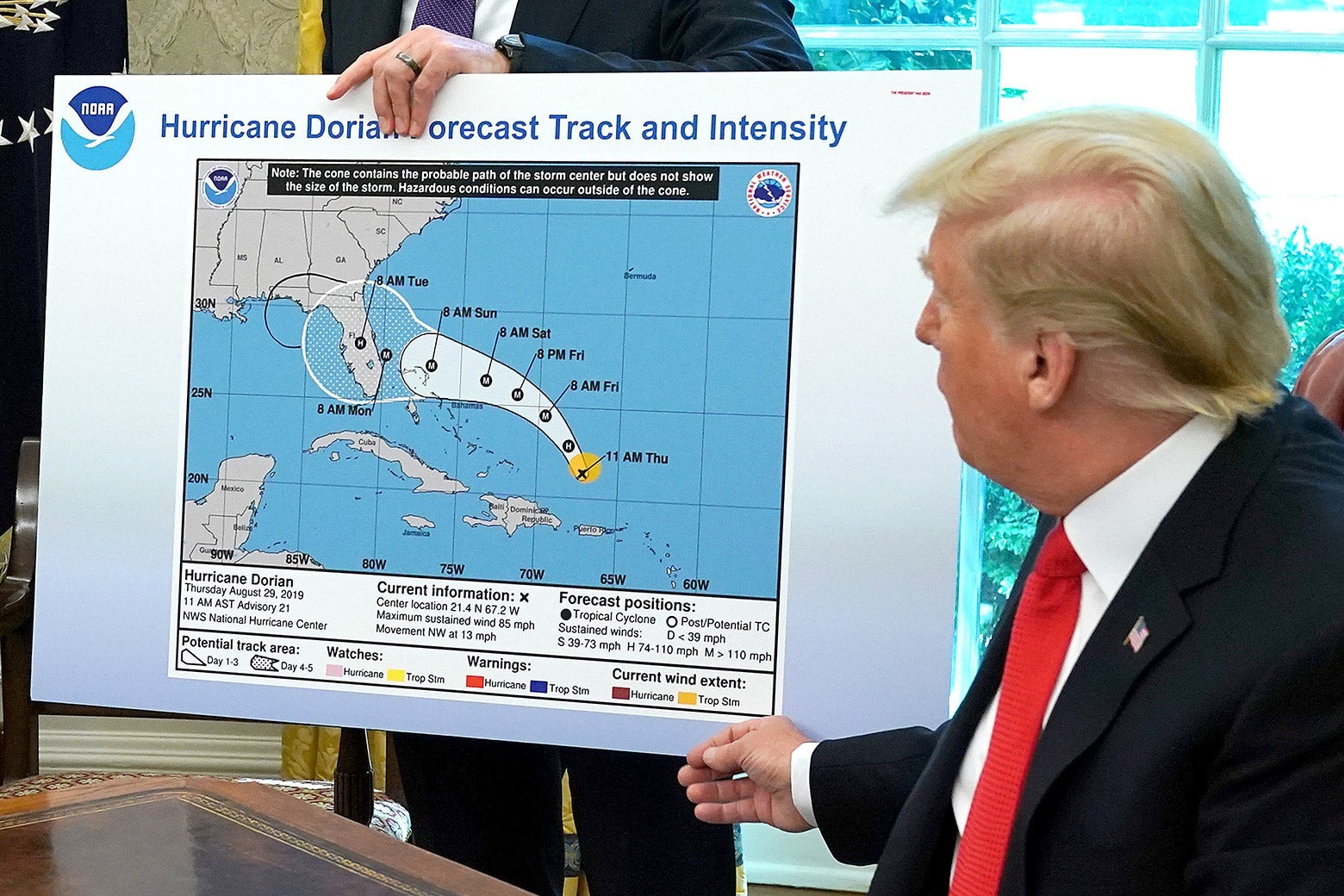
They knew the path of the hurricane and what can happen. Its not like they took a sharpie and could redirect it.

nunya_buisness 96 reads
posted
23 / 25

The argument you're making is full of logical fallacies, including strawman arguments and red herrings, which distract from the real issue at hand. Let me explain how.

No one is claiming the Earth was always a perfect climate for human life throughout history. This is a classic strawman. The real issue is about today’s rapid climate changes, driven by human activity, and how they affect the ecosystems and societies that have developed under stable conditions in the last several thousand years. Whether the Earth was a ball of lava billions of years ago or temperatures fluctuated in the Cambrian period is irrelevant to the challenges we're facing right now.

You also bring up ancient periods like the Cambrian, a time when humans and the ecosystems we depend on didn’t even exist. This is another red herring—bringing up irrelevant points to distract from the central argument. The climate has indeed fluctuated over millions of years, but it’s misleading to compare those changes to what’s happening today. The question is not whether the Earth has gone through warming periods in the distant past, but whether today’s rapid, human-driven changes are destabilizing the climate in ways that could harm modern societies. The fact is, they are.

You also mention graphs showing global temperatures and CO2 levels over millions of years, but these don’t refute the link between CO2 and temperature on human timescales. The rapid increase in CO2 levels over just the past 150 years is unprecedented in the context of modern human civilization. While Earth has seen higher CO2 levels in the past, it’s the speed of today’s changes that matters. The ecosystems we rely on, as well as our cities and agriculture, have evolved in the relatively stable climate of the Holocene epoch. When you reference time periods when there were no humans or even mammals, you’re missing the point entirely.

You also seem to dismiss the increase in global temperatures since the Industrial Revolution, attributing it solely to the end of the Little Ice Age. While natural variation certainly exists, the overwhelming scientific evidence shows that the current warming is too rapid and too extreme to be explained by natural factors alone. You’re asking to "rule out natural variation," but we have. The evidence consistently points to human activity—primarily fossil fuel use—as the primary driver of recent climate change.

Finally, you bring up the Medieval Warm Period (MWP) and claim it was warmer than today. This isn’t accurate. The MWP was a regional event, and while certain areas, like parts of Europe, may have been warmer, global temperatures were not as high as they are today. And regarding the claim that there's no correlation between CO2 and temperature, modern data clearly shows a strong correlation between rising CO2 levels and rising global temperatures over the last century.

In short, your argument sidesteps the actual concerns and focuses on time periods irrelevant to the challenges humanity faces today. The evidence for anthropogenic climate change is overwhelming, and your references to ancient history and geological timeframes don’t address the real, pressing problem we’re dealing with.

BigPapasan 3 Reviews 66 reads
posted
24 / 25

...choked up and nearly broke down while he was reading on live TV that the barometric pressure in the area of Hurricane Milton had dropped 50 millibars in ten hours.  He blames climate change - but what does he know compared to willy?

 
http://www.youtube.com/watch?v=iqDLP-8fhnE

BigPapasan 3 Reviews 69 reads
posted
25 / 25

Do you know what a non sequitur is?

Register Now!